Showing posts with label Standard Model. Show all posts

Friday, March 28, 2008

Safety At The LHC

The Science of Conundrums: The Almost Thermonuclear LHC

A discussion on safety at the LHC. Stefan Scherer in Frankfurt, a physicist, science writer and co-author of the physics blog Backreaction, comments: ". . . If something goes wrong, that may wreck the billion euro installation in the tunnel - worse enough - but it would not result in a a 007 like explosion of Dr Blofelds underground lab. . ." See p 13 at this LINK for the full dialog.

Monday, March 3, 2008

Other Headaches In Particle Physics

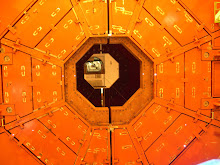
Another piece of ATLAS. Where do neutrinos fit in? Not in the Standard Model. Nor whatever happened to antimatter, when the Big Bang supposedly released equal amounts of matter and antimatter, which should have annihilated each other, leaving only energy behind. Why does the Universe obviously prefer matter? And why isn't the Universe homogeneous everywhere like a field of stars without galaxies if it expanded out from an orange-sized ball? Why is it expanding when gravity would tend to stop expansion, indeed reverse the Big Bang into the Big Crunch? Well there are theories and theories about all this. At the LHC they've got a long list of questions about theories and they think some are bound to be answered from data they expect and maybe don't expect.

Meanwhile Astrophysics seems to be overtaking Physics and Particle Physics. It's like the revenge of Astrophysics. With only 4% of the matter of the Universe accounted for, astrophysicists say, the rest invisible, maybe there wasn't a Big Bang after all? Anyway 96% of the Universe right there, doesn't fit into the Standard Model. It's only a bit of background microwave energy Science leans on and some expansion, the red shift well noted, that is the proof for the Big Bang theory. Besides, where did the orange come from? While particle physicists are attending endless meetings at CERN, the impossible is happening all around us in space.

You might remember black holes being popular as a simple theory of matter accumulating into an unimaginably dense body so small it might appear like a massless black hole, sucking up more matter and energy. After many years of uncertainty, some have been found inside galaxies thanks to space-based telescopes like the Hubble and recently Spitzer and Chandra. But then the theory suggests they're unstoppable and would eventually absorb the galaxies they're in and there are still perhaps a 100 billion or more galaxies and no sign of any big trouble. Then a spectacular find, a black hole from a galaxy 3C321, the death star galaxy in the news last December, erupting a jet of radiation 850,000 light years long, striking another smaller galaxy about 20,000 light years away, and 1.4 billion light years from us.

A black hole releasing considerable energy, except perhaps into some other fantastic dimension, was entirely unpredicted. Only some suggestions of black holes possibly exploding, and Stephen Hawking's 1974 theory that a black hole could decay via a thermal radiation created by the black hole itself, slowly leaking (still unconfirmed) Hawking radiation. If 3C321 can happen, then what of unexpected results at the LHC?

Now of course someone at NASA or somewhere is bound to post a patch for black hole theory and dine on the celebrity status for a lifetime, like all scientists dream of. But how would you patch Geneva, Mount Blanc and a lot of great ski resorts popular with grad students, postdocs and trendy physicists at CERN, patch that and all of Switzerland and a good chunk of France, say to Marseilles?

Some are worried over at CERN. Not officially, like don't bite the hand that feeds you. There's an unusually smooth PR operation going on at CERN to keep things humming, even professional seminars on how to handle the media in Spotlight on the media. Mind you everything is above board and transparent with terrific open access to most anything going on at CERN. You won't find any conspiracy or conspiracy theorists. If you dig hard enough into private online blogs, you'll discover a few cool and amused dissenters. There's edgy good fun in cold war rivals, ATLAS and CMS, each calling the other the enemy. And gallows humor, like the Doomsday Machine. All they need is a Dr Strangelove. Don't worry about black holes. There's this special radiation.

And if you've still got a headache, be brave. Take one LHC with a little superfluid helium before bedtime and you should be fine in the morning.

Physics' Big Headache Or Why Build The LHC

Testing thousands of lead tungstate crystals for ECal. The problem is the Standard Model in Physics which seeks to unify the weak force, the strong force and the electromagnetic force, 3 of the 4 major forces, gravity left out because it has so little effect on the subatomic scale, particle physicists think. Anyway they're obliged to, because gravity refuses to fit in.

What they've got since the 1960's is chunks of theories that seem to work fine as parts of the puzzle, but at the very least other pieces are missing. And if they don't find them, then the Standard Model might be no better than a Ptolemaic theory of sun and planets going around the earth.

The Standard Model is messy too. It's not simple and elegant like Einstein and Newton. It won't give us values for particles. They have to be arrived at through experiments with colliders like the LHC. In the breakthrough Electroweak Theory, uniting both electromagnetism and the weak force, add any value like mass to these equations and they don't work. Then all particles have no mass. And they should all travel at the speed of light. This is the absurd reality of particle physics. But it won a Nobel Prize at CERN, so experimentally confirmed in part. What are we doing then, imagining the Universe? Enough to give any physicist some sleepless nights and a cosmic hangover in the morning.

But physicists cling to the Standard Model because they don't have anything else except stranger theories without a shred of experimental proof. All the Standard Model needs is some improvement, like a new theory to confer mass on particles from the outside. Enter the theoretical Higgs boson. At CERN they're hoping to find it with the LHC, or maybe create a Higgs field from a hadron fireball. Gone are the days of simple atom smashing. CERN actually wants to simulate on a small scale with colossal energies, what conditions were like 13.7 billion years ago, when there must have been a Higgs field, a billionth of a second after the Big Bang.

To do so a stone's throw from the Geneva Airport is taking an incalculable and unnecessary risk.

Who wants a theoretically dangerous anything in your backyard? Maybe if there were some real benefit, but is anyone really the wiser or better off when a $10 billion theory is confirmed or denied, and of interest only to a small group of physicists?

It's about as pointless an exercise as the Tower of Babel. Granted it's way more sexy. Science Porn, Boing Boing calls it.

Sunday, December 9, 2007

Science In A Conundrum

Everybody seems to think Science is a good thing and here to stay. It's right up there with the age old forces that drive the world into the future. Politics, Business, Culture and Religion, except that it is, if not a new idea, a recent application of it to everything. A new philosophy and method of dealing with the planet and our existence. It's a good candidate as the rival to all religions. It has all the trappings of one. Imagine 2,000 PhDs in one place like CERN, the veritable Vatican of Particle Physics.

Reminds me of a Chevy Chase movie, Fletch. Chevy on the lam, hiding out in a hospital, nervously putting on a lab coat and suddenly surprised by guys in lab coats, wondering how to act like a doctor, nodding Doctor, shaking the hand of, Doctor, How are you, Doctor, an exercise in Doctor flattery, desperate to fool them and join the club. Might have done the same skit in Oxford, where conundrum was coined, among the medieval Doctors of Theology, wearing one of their gowns. These Doctors of Theology then and the Doctors of Science have much the same allure. The jargon they share, a sanctimonious air a trifle condescending, and no appetite for criticism. Disagreeing with the other doctors could have got you burned at the stake. Especially if you were a layman with no grasp of their Central Dogma. Even Biologists today have a Central Dogma, as it is actually called: Life comes from life, though they must be arguing about it now.

There's the Standard Model for Particle Physics, extremely complex, much admired, though with a number of big holes that need patching with more theories. Quantum Mechanics, another backbone of Particle Physics that looks sound from every angle and even works, is a jungle of probabilities that a statistician might have dreamed up. Einstein had an early hand in it, but the more he worked on it, the less he liked it, calling it spooky. Its randomness after his theory of General Relativity just didn't make enough sense. No one since has been able to make these theories agree, not even Stephen Hawking. Perhaps Einstein is still right. He hasn't been proved wrong about anything. Quantum Mechanics, as he said, would be acceptable if it were completed by hidden variables. Interesting too that Einstein didn't pursue experiments to validate his theories, but many physicists have since. Certainly his stature was one of a prophet. But mere scientists aren't content with fireside theories scribbled on the back of an envelope.

Scientists want action today, like the Large Hadron Collider, $8.7 to about $10 billion worth, depending what formula you use. A quantum gamble by over 2,000 physicists at CERN essentially to prove or disprove a theory that is vital to another theory, the Electroweak theory, part of the Standard Model. They're looking for the theoretical Higg's boson, perhaps a big particle or a small particle, that confers mass on other particles. If they don't find it they might have to throw out the Electroweak theory and try something else. It might even mean going back to the chalk board like Einstein and start from a general theory to unify all four major forces, instead of 2 with the Electroweak. In the wings too, are String Theory and Supersymmetry, dying from lack of experimental funding. Incidentally, CERN will be looking for any sign of life in them, at the LHC.

This is big stuff, the Science we see and the Science we don't see much of. Today's Science rivals the power of the Church in its heyday that called for a Crusade to the Holy Land. Here a small army of physicists have called for a crusade of their own to find the Higgs, dubbed the God Particle, and capture it for a split second at least, even if it means possibly annihilating, not Jerusalem, but in this case Geneva, sitting beside the ATLAS experiment, the biggest one of all 4 big ones, just outside the 27 km Large Hadron Collider.

The Conundrum then is, do we trust an upstart Science, to steer us into the future? With Science itself battling conundrums, with no clear idea where it's headed, except towards some sort of progress, a promised land? For every step forward for Science, there are two steps back for it and us, usually costly and dismissed in a face saving way as a larger problem you wouldn't understand, requiring more study and funding. Cancer is now many cancers, a staggering discovery, billions of dollars later while cancer mortality overall hasn't changed statistically. Indeed overall numbers of cases have gone up due to modern scientific progress in things like day-to-day drugstore and hardware store chemistry and nuclear power plants. And what about antibiotics that turned scientists into demigods until drug-resistant and tougher pathogens surfaced and tarnished their infallibility. AIDS the new demon still isn't pacified 40 billion dollars later. Sounds like we finally have to buy Science and all the scientific dogmas and promises on Faith alone, like the Church.