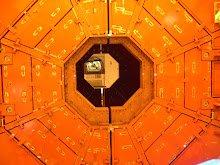
What could go wrong with 2 x 27 km of beam pipes? The engineering and theoretical worries have been addressed from many angles. CERN has constructed a remarkable machine with many key safety features built in. Speculations on what might happen when the LHC is switched on are all in the realms of theory and lessons learned and extrapolated from much less powerful colliders. No real guarantees on what to expect from a unique experiment. Beyond the public discussions, from my overview, there's one big thing that hasn't surfaced in seminars and published papers or the media.
At the LHC you've got all the ingredients for a two stage thermonuclear proton fusion and trigger for a helium fusion bomb. The protons are hydrogen stripped of electrons in the beam pipes and the helium is the coolant for all the superconducting magnets in the main ring and in the giant detectors like ATLAS.
The helium is an enormous amount of gas chilled and compressed down to 60 metric tonnes of superfluid helium. Protons are in abundant supply, circulating in the ring at 99.99% of light speed in opposite directions, in nearly 3,000 bunches of about a 100 billion per bunch per beam line or 6,000 x 100,000,000,000 or 600 trillion protons in the system.
These aren't ordinary protons. Because they've been accelerated to near light speed, each proton has 7 TeV of energy, or 7,000 times more energy than a proton at rest. Recall what Einstein said about bodies accelerated to speeds approaching light. They gain mass! And recall the Lorentz contraction. At these phenomenal speeds, bodies are foreshortened, appearing smaller than when at rest.
Has something so basic in physics been overlooked? A great number of very heavy protons, enormously compressed, at least 1200 million colliding every 25 nanoseconds, travelling at 11,245 laps around the ring in one second, so all 600 trillion would mingle within say ATLAS in less than a second. Of course not, but then what if there were more collisions and pileups, so that
the anticipated small fireball burned all the protons, expanding and overwhelming the detector, rupturing a helium line? At expected temperatures of the proton fireball, more than 100,000 times the core temperature of the sun, wouldn't that be enough to fuse the captured helium present?
Rather an unfortunate choice to use fusible helium as the coolant, like the location of the LHC near a big city, Geneva and much of the UN apparatus there.
Even if CERN did achieve a small fireball, a small helium leak would fuel the fusion reaction and you would have, not an LHC, but a nuclear fusion reactor. The enormous magnetic fields might contain the plasma for a while, but with the detectors not designed to be reactors and many combustibles present in the calorimeters, like silicon chips and fiber optics, any detector could burn from the inside out. To shut off the supply of helium would be difficult, depending where the valves are. It would be a runaway situation with helium flooding the test cavern in short order. Working at the world's largest cryogenic LNG plant in the 1980's, I have first hand experience of what can go wrong even when you have the best engineering and operations people. Since the plant was on a stretch of sandy beach, if something big went wrong, then we would have only blown up about $2 billion dollars and a beautiful high tech machine. Not Geneva or the UN or a lot of fine Swiss watches and a major banking center and who knows how many people.
This type of proton-helium nuclear explosion is certainly possible. Hydrogen bombs work in a similar way. An initial small nuclear explosion fusing a supply of low molecular weight gas. Thermonuclear bombs are currently the most powerful by far.
In order for the LHC to blow up, the question is whether or not there is enough proton mass present to produce a big enough fireball to rupture these tiny refrigerator freezer type channels in the detectors containing helium. In a worst case scenario would we have an explosion, a fireball, a nuclear explosion or plasma erupting? How would a helium fusion bomb compare with a hydrogen bomb? Just how massive could it be given a 60 tonne contained supply of helium. Could it all fuse and be far more catastrophic?
These are serious and important questions, not posed by the media or CERN, at least not publicly. We need an answer soon before the LHC starts up this summer. A lot of people's lives could be at risk. If there is or isn't a danger, we should have the facts and the math from CERN. Any physicists care to comment?


 Cointrin