In the days before Madison Avenue, public relations and spin doctors, Science was free to speak for itself. Like any other activity it was criticized and judged on its activites and results by media and the people. If the public had questions, the scientists answered them. Political games were for government and business. Now big science instituitions and labs with their own bewildering bureaucracies, have developed an interface to present an ideal world of science through their press offices and lobbyists. They sell science like GM sells cars. Somehow the media seems not to have noticed the difference, taking spin doctors' science press kits and sound bite analysis at face value.
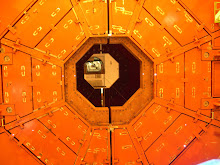
Camera shy bumbling scientists with thick accents who were honest about what they were doing, if you could follow the science and what they said, have now been pushed behind closed doors while the media gurus have taken over. At CERN they go a step further and stage media science events, like the big ballyhoo September 10th to show off the Large Hadron Collider during a preliminary start-up test. A modest start-up showcase for an extremely powerful atom-smasher that smashes nothing that day is played out as a big success and a victory for LHC safety. No more doomsday. Doomsayers all wrong, CERN always right. Then three big things go wrong which are skillfully downplayed. While the little ball of protons zips around, the CMS computer system is being hacked by the Greek Team and that for 2 days at the home of the World Wide Web? A 30 tonne surface transformer blows 36 hours later during a thunderstorm. Then a massive failure occurs in the cryogenic cooling system which cripples an eighth of the 17 mile collider ring. Very little information released, but a lot of reassurances on "teething troubles" at the giant baby collider.
It can get worse. The latest surprise from CERN is a new paper published which finally comes to grips with part of the problem with the helium used in their massive near absolute zero cooling system. The CERN paper dismisses every safety concern with helium without considering all of them in "There is no explosion risk associated with superfluid Helium in the LHC cooling system", September 23, 2008, by Malcolm Fairbairn and Bob McElrath of the CERN theory group.
Its focus is helium-4 bosenovas at the LHC and cold fusion during these events.
The short answer is, "We conclude that that there is no physics whatsoever which suggests that Helium could undergo any kind of unforseen catastrophic explosion."
Sounds like these guys were in a hurry, but right behind the Eight Ball. "that that" is fast fast, potential there for a new type of doublespeak. Of course there was an explosive release of one to two tonnes of superfluid helium last time, but that was different. Not a real explosion, more like your radiator exploding, not your gas tank. But the paranormal mindbender winner is, as KFC at the physics arXiv blog said of CERN's conclusions, "That's comforting and impressive. Ruling out forseen catastrophies is certainly useful but the ability to rule out unforeseen ones is truly amazing."
It's a welcome response from CERN even if it is only partial. I first raised the issue myself in ScienticBlogging, July 2nd, 2008, in "Superfluids, BECs And Bosenovas: The Ultimate Experiment" reprinted here on The Science of Conundrums. When CERN didn't bother answering, I contacted their LSAG people via email twice, August 25th and 29th, but included other helium risks like the production of helium-3 via LHC energies ionizing helium-4, where helium-3 bosenovas obviously should also be considered. I received no reply and CERN's paper doesn't address helium-3 bosenovas either. I also wrote about nuclear events in helium, certainly a potential danger in helium-3 and even possible plasma and fusion reactions of helium-3 at the LHC. Again no answer from CERN. Only this sweeping rebuttal: "There is no physics whatsoever which suggests that Helium could undergo any kind of unforseen catastrophic explosion" Is this science or speculation and politics? Don't worry from CERN, but this time not from the CERN PR department, but their CERN theory group.
If this sounds a spectacular failure in addressing safety issues honestly, well what other explanation is there? All they had to say was Helium-4 Bosenovas are Bunk, and Cold Fusion of Helium-4 Stinks. Of course we hope other physicists will examine CERN's 6 page paper and let everyone know if CERN's arguments are sound. Even if they are on Helium-4, one mosquito does not a summer make. Though there have been plenty of light speed protons in another CERN public relations context, masquerading as mosquitos.
If the politics of safety can override safety concerns, like chicks sprawled on red sports cars, are there other similar sales jobs on safety approximating the scientific? Where is the CERN Model hiding out? Look no further than the pharmacuetical industry. When people die, safe products are recalled. Tons of safety reports and tankers on a magazine sunset, and then a giant oil tanker spills and kills birds and animals and fish by the thousands. With 6 months of downtime at the LHC thanks to accidents can happen, they've got plenty of time for gearing up for a new sales campaign, CERN TV commmercials. We're still waiting breathlessly for "Spin the Collider and Win" or "My Best Friend is a Collider / When he gets warm I get hot / Gimme gimme gimme more / My collider / Bang, bang, bang / Big Bang. Be there! Beat Doomsday! Make it happen. Geneva is to die for. Hunker in our bunker or dance the night away. Win a trip for two at participating Dunkin Donuts, your Collider Central. Free Collider Keychain in every limited time only Giant Collider Donut. Careful when you munch. Be safe, dunk first."
Nowadays politics is part of big science. Recently a Climate scientist at MIT, Richard S Lindzen wrote a paper, "Climate Science: Is it currently designed to answer questions?" Although the author states that the focus of his paper is on climate science, "some of the problems pertain to science more generally."
Lindzen notes "the change in the scientific paradigm from a dialectic opposition between theory and observation to an emphasis on simulation and observational programs." The LHC Machine is certainly part of this change from earlier Einsteinian physics to let's see what happens when we simulate the Big Bang.
". . . an emphasis on large programs that never end." Fifty years of CERN and now on a budget of $1 billion a year with a $10 billion broken collider that might never work right.
". . . the hierarchical nature of formal scientific organizations whereby a small executive council can speak on behalf of thousands of scientists as well as govern the distribution of 'carrots and sticks' where by reputations are made and broken." CERN in a nutshell.
". . . the politically desired position becomes a goal rather than a consequence of scientific research." New Physics sought.
". . . scientists adjust both data and even theory to accommodate politically correct positions, and how opposition to these positions is disposed of." Safety or the appearance of safety? Critics are doomsayers who just don't understand.
Well this still works for CERN because it is an enormous organization that has a small powerful directorate and a Director General with Presidential Powers, 'carrots and sticks'. So big and influential in physics that those within and those outside are wary of demurring on anything. Even 20 EU governments that support CERN financially applaud rather than criticize, but then they're not scientists, or cost accountants, and just as misinformed as anyone else. If there are any diplomatic groans, it's probably because the big collider party this October 21st has been called off. In the interests of vitual safety, no doubt here a Virual Inauguration would be safer for Heads of State. Cheaper too, a few souvinir hardhats FedEx'd. Click for Bollinger and caviar now.
No doubt CERN will spring for the real thing. These guys pay their bills. It's prestige that still counts. With participation in other nuclear labs in Europe and friendly relations with many others worldwide, CERN amounts to something like the Church of the Middle Ages. Not based in Geneva for nothing. In 1955 the Swiss Government gave CERN carte blanche to operate in Switzerland as part of the deal to locate its operations in Switzerland. The list of concessions and priviledges CERN enjoys gives it the power of a city state (currently 2,600 staff, plus some 7,931 scientists and engineers, in Wikipedia) or in modern terms, that accorded to a foreign government's embassy and its diplomats. When CERN expanded into France in 1973, the French government was more circumspect but awarded CERN similar if more limited powers. Neither country though has jurisdiction over CERN, its property, its personnel or its activities. Though the French have reserved some rights including the right to intervene if there is a threat to France. If CERN blows up Geneva, Switzerland will have to sue Fermilab. An obvious mistake to put an organization above the law, like we didn't know the gun was loaded. Anyone in Switzerland or CERN care to bet that the obvious mistakes are the most statistically significant?
Surely if there were doubts within CERN as to problems or even the advisability of the Large Hadron Collider in the first place, we would hear about it? Not much has slipped through the cracks in the CERN PR department except their tactics. One source is CERN archives. Some CERN people have found themselves embassassed in hindsight when their candid comments were recorded in CERN videos, transcripts and documents.
One insider has recently commented, not realizing there was some unwritten code of silence. A CERN physicist, Tommaso Dorigo who works at the LHC CMS experiment, wrote in his blog, A Quantum Diaries Survivor, "In fact CERN appears a bit up-tight about the latest events in sector 34 of the LHC tunnel. He goes on to say ". . . since my blog is targeted as a possible source of leaks. . . And if I play fair, maybe I am allowed to survive here, and maybe one day I will stop being threatened every other day, in the name of protecting internal information of the experiments I am a part of."
Dorigo concludes, "Of course, I still assert my complete disagreement at a way to conduct scientific experiments paid with your tax money which resembles the management of the Pentagon rather than an agorà of education, research and scientific communication."
--Alan Gillis
References
Fairbairn, Malcolm and McElrath, Bob. "There is no explosion risk associated with superfluid Helium in the LHC cooling system", September 23, 2008, arxiv,
http://arxiv.org/PS_cache/arxiv/pdf/0809/0809.4004v1.pdf
KFC. "Forget black holes, could the LHC trigger a "Bose supernova"?, September 29, 2008, the physics arxiv blog, http://arxivblog.com/?p=645
Gillis, Alan. "Superfluids, BECs And Bosenovas: The Ultimate Experiment At The LHC", July 12, 2008, The Science of Conundrums, http://bigsciencenews.blogspot.com/2008/07/superfluids-becs-and-bosenovas-ultimate.html
Gillis, Alan. "The Almost Thermonuclear LHC", March 17, 2008, The Science of Conundrums, http://bigsciencenews.blogspot.com/2008/03/almost-thermonuclear-lhc.html
Lindzen, Richard S. "Climate Science: Is it currently designed to answer questions?", September 27, 2008, arxiv, http://arxiv.org/ftp/arxiv/papers/0809/0809.3762.pdf
Dorigo, Tommaso. "An agorà of education and scientific communication", September 23, 2008, A Quantum Diaries Survivor, http://dorigo.wordpress.com/2008/09/23/an-agora-of-education-and-scientific-communication/
CERN / Switzerland. "Agreement between the Swiss Federal Council and the European Organization for Nuclear Research . . .", June 11, 1955, CERN Legal Services, http://documents.cern.ch/archive/electronic/other/legal/articles/LSL00000012.pdf
CERN / France. "Agreement between the Government of the French Republic and the European Organization for Nuclear Research . . .", August 30, 1973, CERN Legal Services, http://documents.cern.ch/archive/electronic/other/legal/articles/LSL00000010.pdf


 Cointrin