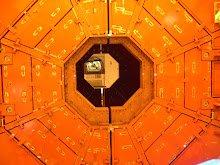
Alan Gillis Reports As usual CERN physicists at the Large Hadron Collider have been excited by finding nothing yet. That's months after the big media event March 30, 2010 for the first proton collisions at 7 Tera (or trillion) Electron Volts that smashed a few thousand protons. Like 10,000 CERN mechanics starting your new car and how-about-that bonus puffs of proton smoke out the exhaust. Not the full power perfectly safe 7 TeV proton collider from hell we were led to expect from CERN PR. Or the 14 TeV fire-breathing dragon delayed to 2013 because of safety issues and the need for a year's worth of further repairs and upgrades, after the LHC crashed in a spectacular $40 Million accident back in 2008.
Suddenly all that's changed. From the purring collider slowly reving up in CERN's 27 km garage, there's more bang per buck from the $10 Billion LHC. From protons as fuel CERN jumps to the heavy ion run, from say an octane rating of 1.0 for protons, the new heavy lead fuel delivers a whopping 82.0 octane (82 protons in each heavy ion) and the LHC smashes all records for power.
Lead ions are now colliding at the LHC since November 7 and will continue for a month through December 6, 2010. A look back at this year's LHC performance improvements and data highlights shows what a slow slog it's been. Lead ion collisions could radically change all that before it's back to protons and repeat the ion run for another month about this time next year, and then shutdown to rejig the LHC for all of 2012.
The big change? No Big Bang Party for the media.
What we get are some great snapshots of collider fire power. No champagne, no paper hats. Ion collisions more or less in line with expectations. It's of course too early to say what happened exactly, so CERN is still excited by finding nothing yet. Back to square one data analysis but with more excitement. Suddenly we have to wait again for results that could be way more exciting if there's any evidence of New Physics at these colossal new energies. That's the big deal right now: tremendous LHC power equals tremendous excitement. It's roulette on a new wheel and the sky's the limit. Wow!
The first few lucky Pb-Pb collisions happened during the set-up phase before stable and focused lead ion beams, at in ordinary proton power terms, a low for the LHC collision energy of 2.76 TeV recorded at ALICE (bottom image) still far higher than at other ion colliders. Though the LHC is poised to go to the max soon or 7 TeV.
Sounds too low to make a fuss at 2.76 TeV ? Yes and no. What the bigger and heavier lead ions absorb in energy and release is far higher than that. These first heavy hadron or ion collisions rocket the Large Hadron Collider into high orbit, well beyond anything done so far anywhere. According to Fermilab/SLAC's journal SymmetryBreaking, the real energy per lead beam was 287 TeV and so collisions were double that, releasing 574 TeV.
Not exactly or maybe unofficially. CERN hasn't revealed what the highest energy collisions were. SymmetryBreaking bases their numbers at, in proton terms, 3.5 TeV so knock off about half those 287 TeVs per beam until CERN Big Bangs the max and says it's official. Even so CERN achieves a formidable power though why not make it clear even to Fermilab/SLAC? ATLAS shows collisions with stable beams at whatever TeV. At CMS, well pick a number. CERN has kept us guessing before during other earlier (modest as it turns out) LHC milestones. It's the simplified CERN PR approach to success: We did it! (Not at 1/400,000 of what we wanted.)
Should get the 574 TeV full monty later this year. In 2013 in any case with a fully amped LHC or 14 TeV proton energies, lead ion collisions will be around double 574 TeV, or 1148 TeV. Even so each ion today packs an unbelievable punch.
The applied LHC energy and acceleration to very very near light speed, makes each heavy ion much heavier and enormously powerful. A beam of these ions can bore through say a dozen meters of solid stainless steel, producing a small peephole big enough to see through to the other side. And when beams collide?
A Swallow Does Not A Summer Make
First result: We're still here but how long will that last? CERN has only started the big adventure into the unknown with a modest display of heavy ion collisions. What we do have before the evidence is in, is apparently what physicists are calling an ion furnace where the spectacular heat of heavy ion collisions is so great as to dwarf the core temperature of our own sun, and produce a new state of matter a 100,000 times hotter than inside the sun, an undifferentiated absolutely slippery state where particles melt into a new Quark-Gluon Soup. It could be called the ultimate plasma state of matter that physicists think formed in the blink of an eye after the Big Bang. Though apparently not a CERN first or second. Recently re-analyzed data shows Quark-Gluon Plasma was produced at much lower energies at about 0.9 TeV in proton terms during gold ion collisions at RHIC. That's another but much smaller low power collider, the Relativistic Heavy Ion Collider at Brookhaven National Labs.
The LHC ion run discussed in SymmetryBreaking is shooting for much higher power or effectively 14.7 x RHIC and temperatures double RHIC's or 500,000 times the core temperature of the sun. And maybe double that to a million times hotter in 2013.
The Known Unknown And The Unknown Unknown
Unofficially CERN thinks they've nailed the Soup Theory and should be able to produce their own data to support it sometime in the future, if there is still a CERN around in a new altered reality being engineered by CERN now. The more collisions coming at these and way higher energies, the more data for research but also more risks of producing the unknown or some expected and maybe dangerous particles or collider objects like Micro Black Holes and Strangelets that if metastable will affect ordinary matter or even destroy it and the planet.
Then there is always the unexpected in any new experiment and if you believe CERN they're hoping for the unexpected too. Anything would be good it seems. Nothing can be bad, as Dr Fabiola Gianotti, team leader of 3,000 scientists at ATLAS implied recently in The New York Times:
“We have been waiting so long,” she said. “Only good and beautiful things are coming."
The problem is even if CERN gets bragging rights on more and more collisions at higher and higher and higher TeV energies thanks to greater to spectacular luminosities still years away, even without apparent damage to the collider and the world, safety is not assured by any means. For one thing particles ejected from collisions at other colliders are not all contained and some escape. At much higher LHC energies so could dangerous collider objects. Detected or not they might or might not decay harmlessly outside the LHC. If stable they could slowly grow over months and decades or who knows how long and when big enough, then we'll see the threat without the need to agree on theories and complex and mesmerizing data, too late to do anything about a matter destroying object in CERN's big backyard chomping on Geneva and threatening the earth or maybe popping out into space and destroying the moon. It's speculative but what about "Only good and beautiful things are coming."?
 The LHC Gateway
It's Reality Sci-Fi. We don't know what the LHC can do and we don't know if disaster will strike. We do have the gateway, a very real $10 Billion experiment. Besides that all we have are a few theories on safety and some reasonable assurances from other low power collider experiments plus some preliminary and minimal results from the LHC. And a lot of don't worry PR from CERN to convince us that the LHC is a perfectly safe Dream Machine that will one day unlock the secrets of matter and the cosmos.
Not perfectly safe yet. What's not being yodeled by the Happy CERN Wanderers a stone's throw from Ja! de Alps, is the very real need for big time upgrades to make the LHC safe beyond the $35 million for the 2012 shutdown and fix, like another $1 to $2 Billion extra to protect the LHC from its own mounting radiation damage (another problem largely ignored by CERN when the LHC was designed and built, like those other problems of poor quality control of the busbars and poor design of the Quench Protection System that both caused the $40 Million 2008 catastrophic failure of the LHC that still needs that $35 Million in 2012 for repairs and upgrades to take a full year to go to a safe 14 TeV).
CERN's lederhosen are down around their knees but they're still not embarrassed in public, because there's no CERN Press Release on that, so no CERN butt showing on the cover of the Rolling Stone.
Yet the sexy LHC has another surprise in its gigantic PR closet. This one better on the accordion and ump-pa-pa if money and beer are no object, but these are hard times. Is $10-12 Billion enough and a Billion more for operations per year for the new already super expensive (so far empty) frontier of High Energy Physics? Probably, actually certainly not, but not in print please. Shhhh we need the PR first, danke. Then comes the shiny new VLHC with something like the mind-boggling power of the abandoned Texas SSC, the Superconducting Super Collider now recycled into a perfectly safe (no PR intended) hole in the ground. What a collider that would have been, a ring 50 km around almost big enough for Dallas? What a terrible blow to particle physics. No wonder CERN has so tenacious a hold on its Ring of Power.
VLHC Anyone?
We still don't know if we'll get any mindbending results from this LHC and will in any case have to go higher to a galaxy very far away to give particle physicists another shot at SSC glory. Why not a souped-up version of the LHC or the Very Large Hadron Collider? Another $X Billion or more? Sure for 33 TeV. CERN has been betting on this upgrade before LHC construction ended, looking 10 years down the road, now 20 after all the Big Bang headaches. Had a big quiet meeting about it in Malta recently. In for a proton, in for a Bigger Bang. But first ramp up the PR research. Develop info mazes where journalists will fear to tread. Don't say needy deserving physicists and poor unhappy half-finished VLHC. Start with Wunderbar Collisions of course. With important spinoffs for BMW and Mercedes in CERN's other bumper-to-bumper network, no better not. Life Ja! is not easy in der Furorbunker, sorry the VLHC Group Think Tank where wistfully Colliders Are Forever.
If all were well at CERN maybe we wouldn't mind being kidded by CERN PR. Might enjoy the thrill of the promised unknown while duped into serenity. Problem is a great deal of effort expended on CERN security and safety is largely from the clattering of keyboards at CERN PR trying to get that just right. There are of course machine safety systems aplenty and they can fail as we've seen in 2008. In the real world at CERN we can only hope that the unsung heros of the Maintenance Department and when all else fails the 2 man teams of Pompiers, can provide safety on the fly as they stand between a rock and a hard place, a stone's throw from Geneva.
The other sort of safety is hard science, but safety papers and arguments regarding experiments are sparse and theoretical and some need revision as there are internal inconsistencies and errors. Other studies are missing. Subsequent new theories and research that bear on possible LHC results have yet to be fully considered. Worse, there are also other possible spooky interpretations of CERN's House of Cards. Here's another rare insight from the CERN shop floor, again from Dennis Overbye's recent article in The New York Times:
In interviews recently, scientists and managers said that they had been too eager to get the collider running at full power in 2008. “In perspective, we may say we started too ambitious,” said Lucio Rossi, a superconductivity expert who joined CERN from the University of Milan in 2001. One reason, in his opinion, was arrogance.
A Brief History Of The End Of The World
Start here. While we're waiting for new revelations there's a backlog of papers on the curious evolution of the hard science of safety at the LHC. There's Professor Eric E Johnson's monumental and entertaining study of CERN's soft safety mythos and other mystifications from a legal perspective in "The Black Hole Case: The Injunction Against the End of the World."
A summary and further comments by Professor Johnson and some CERN feedback like Why didn't you talk to us first? in New Scientist; Professor Johnson interviewed on World Radio Switzerland; these and several major articles on Johnson's 90 page paper by journalists like Kevin Hassett of Bloomberg, can all be found via links from Johnson's blog, Pixelization.
Then there are dozens of my articles here in The Science of Conundrums, NewsHammer and elsewhere, and many of them syndicated in the Chicago Sun-Times and USA Today that cover new and similar shakey ground under the LHC going back to 2007. Here's a sardonic favorite from the Alan Gillis archives: "The Black Hand Of Dr Cern". Wacky? Well compare this with Professor Johnson's coverage of bizarre safety assurances by CERN's LSAG and SPC, in section IV.G "The Rise of Certitude" pdf pages 31 to 34 from the above link to "The Black Hole Case...".
Other major studies critical of LHC risk can be found at www.Risk-Evaluation-Forum.Org/links.htm
 Strangelets Yes We Have No Strangelets
If it can't get any more self-serving at CERN, well there's more sauce from the gander, in Eric Penrose's recent startling and comprehensive review of CERN's creative cookie cutting strategy on Strangelets, "How CERN’s Documents Contradict its own Safety Assurances: Plans for "Strangelet" Detection at the LHC" at http://heavyionalert.org/
CERN minimizes risks of whatever sort, but Strangelet dangers are here now if uncertain. Strangelet production starts with Quark-Gluon Plasma discussed above and likely produced in this first ion run. With more and more lead ions colliding at the LHC at higher and higher luminosities now through December 6, Strangelets are the new frontier in planet disaster and Micro Black Holes might show up as well. No, says CERN and CERN might be right.
But if CERN's credibility is an issue and it is, why should we believe what CERN says? As far as Strangelets go, why build a separate super CASTOR detector specifically to detect Strangelets from collisions at the CMS experiment? To detect Centauros with CASTOR of course because CERN says Strangelets won't be produced but Centauros might be. Then why look for Strangelets? The sky cannot fall down but maybe it will. It's as goofy as that and deadly serious. Yet science journalist Alan Boyle in CosmicLog gives CERN a sympathetic hearing:
The CASTOR researchers themselves voice no concern about a catastrophe. Instead, they see their experiment as a straightforward effort to find evidence of exotic phenomena previously associated with cosmic-ray collisions, including centauros and strangelets. The doomsday connection is being made by the doomsayers themselves ... plus maybe a few physicists exercising their imagination.
CASTOR researchers work for CERN like BP researchers work for BP. Doomsayers work for both but won't risk being censured or banished by speaking up in public. We all wait for a maybe/maybe not accident to happen and that includes journalists. Doom scenarious don't materialize out of thin air as we find out later from journalists when it's too late. There are causes and dismissing all risk or saying nothing starts the ball rolling. Before knocking doomsayers there is perhaps a deeper pathological syndrome attached to saying or doing nothing in some cases, a conscious or unconscious death wish that gets doomsayers talking too.
If that's unfair then we can go back to the usual argument used again by CERN outlined in Boyle's article for the shifting ground under CASTOR: That was then and this is now. CASTOR was designed a long time ago during the interminable LHC time warp or a few years back in real time. In terms of physics as understood then. To sum that up, Strangelets are not expected due to recent data analysis from RHIC's heavy ion research. "The theoreticians are changing their minds." said Yasar Onel who works on CASTOR, as quoted by Boyle.
CERN Logic: That Was Then. So What?
Fine, but think that through. CERN was building a detector for Strangelets that CERN thought could be produced at CMS then, that clearly demonstrates a disregard for safety at the LHC. CERN was going ahead regardless of consequences.
What has changed is not CERN attitudes to safety but the theoretical nature of Strangelets, from hints at RHIC. So CERN is off the hook for Strangelet production if CERN is right about RHIC data, that Strangelets shouldn't form in very hot heavy ion collisions at the LHC. But what happens when QGP cools and decays?
How are any of these twists and turns down the CERN maze reassuring?
CERN didn't understand hypothetical Strangelets but now they do? Uncertainties then in physics, but not these uncertainties now? How can we be confident about the present state of theoretical knowledge when according to CERN or any physicists, physics is a science in progress? What can we know for certain? That theories change, that the sometimes dangerous unknown can rear its head? Doesn't this happen daily in all the sciences?
Collider Good. Results Good.
Not at CERN it seems. At the LHC no matter what happens we're safe from hypothetical knowns and unknowns. This at the world's biggest and most powerful machine, the biggest experiment ever, engineered for a very different scale of cosmic discoveries forced into being by colossal LHC energies, with no possible planet shattering impact or local threat? No chance? That's PR/BS. CERN has bet $10 Billion on a scaled down Big Bang. This is an event that physicists say can produce some of the expected hypothetical and maybe the unknown at the LHC. That's why CERN built the LHC to find out what will happen at the LHC.
The amazing collider and its cleverly engineered bigger and better firestorm also has an infectious back-reaction. CERN's heady confidence in the machine spills over into the unknown results that can't be bad. Collider good, results good.
If tiny Strangelets and tiny Black Holes (expected by CERN but also denied by CERN) shoot out of the LHC, will they ever be detected? Even if they are, what can stop them from devoring and transforming matter into more and more Strange Matter and bigger and bigger Black Holes if they are merely detected? CERN has no magic box to collect them and no charms and chains to rattle to spook them out of existance and certainly no anti-mBH or anti-Strangelets to sprinkle on them to destroy them. There's only mumbo-jumbo for planet destroying collider objects that might surface years later, though I suppose CERN's PR department is up to the challenge.
You might read this yet in the CERN The Bulletin: Strangelets and mBH are keeping CERN physicists awake all night . . . but scientists have taken up the challenge and are ready for the future.
--Alan Gillis
CERN Studies On The 2008 LHC Accident
Risk Panel Report
Executive Summary
"It cannot be refuted that issues with quality and a complex and complicated design are responsible for the incident of September 19, 2008."
http://indico.cern.ch/getFile.py/access?resId=0&materialId=2&confId=53467
The Sector 3-4 incident at the LHC:
fault tree and corrective measures
http://indico.cern.ch/getFile.py/access?contribId=2&resId=1&materialId=slides&confId=53467
Task Force Report
Safety of Personnel in LHC underground areas following the accident of 19th September 2008
http://cdsweb.cern.ch/record/1184225/files/CERN-ATS-2009-002.pdf
Report of the External Advisory Committee with respect to the report of the Task Force on Safety of Personnel in LHC underground areas following the sector 34 accident of 19 September 2008
http://cdsweb.cern.ch/record/1186208/files/CERN-%20ATS-2009-003.pdf
Superconductivity: its role, its success and its setbacks in the Large Hadron Collider of CERN
http://iopscience.iop.org/0953-2048/23/3/034001


 Cointrin