Monday, February 25, 2008

You Appear To Be Running A Large LHC

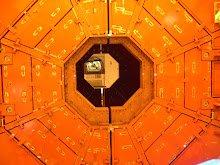
Windows XP at CERN LHC CMS. It's little things like ...please send an error report, that could get us into a lot of trouble. The Compact Muon Solenoid weighs in at 5 jumbo jets with a magnetic field of 4 Teslas at 21,000 amps, the magnet supercooled to -269 degrees C. It's all boggling, the sheer scale and complexity, with 3 other major experiments, each in its own giant cavern and 2 piggyback ones in a monumental 27 km ring tunnel of cryogenics and superconducting magnets for the beam pipes.1700 major interconnections for 1232 dipoles in 15 meter lengths for curving the beams, 400 5-7 meter focusing quadrupoles, another 5,000 corrector magnets. Hundreds of thousands of bolts, 40,000 or 10 km worth of special welds using tungsten gas, 65,000 electrical splices of superconducting cables and a lot of duct tape. For this main ring alone the nominal current is 11,850 amps. Imagine plugging in the CMS toaster for a total draw of 32,850 amps. CERN should be able to do that without knocking out the European Power Grid. But the energy stored in the ring magnets once powered is 10 GJ with 725 MJ in the beam. A small loss is sufficient to quench a superconducting magnet. If somebody turns on their air conditioner in Geneva, the beam could dump 157 kg of TNT equivalent, the ring another 2 metric tonnes.

After sifting through a mountain of info on CERN's friendly websites I'd say the risk of conventional accidents is the first thing to consider. This one failure in the power supply could bring down the entire LHC. Add the other 4 tonnes of TNT equivalent in the CMS. Explosions, electrical fires, rupture of the superfluid helium coolant under considerable pressure in the cryogenic pipe system running throughout the ring and CMS, pumps and compressors failing. The Large Hadron Collider could be a "ten billion dollars or whatever it is" disaster a nanosecond before someone clicks Send Error Report or Don't Send.

Another Big Bang

Billboard at the Geneva Airport. Or better still, VISIT GENEVA while you can. That's the LHC worst case scenario. Or if you believe some physicists, it could be the least of our worries. An unstoppable black hole produced right here could swallow the planet and maybe the Universe. Not yet anyway, probably not this summer when the Large Hadron Collider ring is fully commissioned. Possibly during the less dangerous 14 TeV proton to proton collisions soon after, or more likely eleven months later, when lead ion streams instead of lighter protons, are accelerated and forced to smash into each other at nearly twice the speed of light. Collision energies will be about 82 times higher, or 1,150 TeV.

Of course there is the conventional wisdom of more than 2,000 physicists on site, and another 6,000 accredited in 38 countries, working on this biggest machine of all time, who don't think it's that dangerous or probably not at all dangerous. The only certain thing, is nothing on this scale of a 27 km $10 billion experiment and at terascale 14 TeV energies of 14 trillion electron volts, has ever been attempted.

Add to this, the special conditions of the experiments. As CERN flatters the LHC in its glossy brochures, it's the coldest place and the hottest place in the Universe. Fortunately, not yet. Maybe later this year. Try beating the extreme cold employed, at 1.9 K or -271.3 C or colder than outer space and at a similar vacuum, the extreme magnetic fields, in the CMS experiment 4 Teslas or about 100,000 times earth's magnetic field, and the extreme heat generated by collisions, over 100,000 times the core temperature of our sun. If CERN gets this far without blowing up Geneva, then the LHC ALICE experiment with lead ions at collision energies of an unimaginable 1,150 TeV or 1,150 trillion electron volts, might deliver the Second Largest Big Bang.

In comparison a bolt of lightening, electrons of almost no mass, can deliver as much as 1 GeV or a gigascale billion electron volts. In its heyday the LEP, CERN's earlier Large Electron Positron collider at 40,000 metric tonnes of equipment, hoisted away 8 years ago to recycle the 27 km ring for the Large Hadron Collider, produced energies of 200 GeV.

Fermilab's Tevatron in Batavia Ill at over $370 million, is currently the most powerful collider with a 6.3 km main ring, producing collisions at 1.96 TeV.


Monday, February 18, 2008

Why Science?

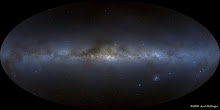
Milky Way Galaxy Center Sagittarius via Spitzer Space Telescope, NASA 2006. Wow! That's one good reason. And it is the wow factor that gets us to throw away billions of dollars every year on Big Science instead of clean water for Africans and a host of other less glamorous problems here on Earth. To be fair, Science is addressing a lot of them, but politicians and people aren't. It's the Hollywood Syndrome. I suppose if Angelina Jolie, who does some nice work for Africa anyway, and Pamela Anderson, who's a good swimmer, were to dance butt-naked at a Clean Water Symposium in Darfur, it would get people watching, maybe showering together.

Still the question is a good one. From measuring things like Time, to changing things for our convenience, why do we go on when we had already reached a comfortable Nirvana of sorts with Science and Technology in the 1950's? It seems the more we question our existance and our situation, the more dissatisfied we are and the more we want to know. It's like Hamlet. There's something rotten in Denmark. Over 30,000 diseases plaguing mankind. And at the bitter end, Death staring us in the face. It doesn't make sense. While religions held sway, and our lives and cultures were manageable, with a bit of something for everyone, at least hope for an afterlife beyond pain, we soldiered on. Now we want what's immediate, what we can do, even if it doesn't really help us or change the planet for the better. In fact we'll take anything rather than this grim reality. Go to the Moon, colonize Mars, wreck our planet, just to get away from it all. We're a desperate culture now, grasping at straws.

This desperation used to be worked out through war, from the primative to the ceremonial, mostly in irrational bursts of war after war, leaving us with one stretch of 50 years or so of world peace in the last 5,000 years. Now that we're so rational and scientific, we now wage war in a rational and scientific way, but we still do it. So Science doesn't look like it's answering anything really important. At best a band-aid solution to some of our hurts, better than nothing. But Scientists will be miffed at this. At the CERN Large Hadron Collider in Geneva they want to understand how the Universe started out after a theoretical Big Bang. This must be important! We have to know this! Yes and no. Maybe the answer is Scientists are as vain as anyone else.