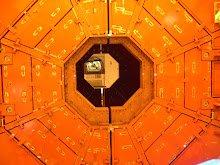
Everybody seems to think Science is a good thing and here to stay. It's right up there with the age old forces that drive the world into the future. Politics, Business, Culture and Religion, except that it is, if not a new idea, a recent application of it to everything. A new philosophy and method of dealing with the planet and our existence. It's a good candidate as the rival to all religions. It has all the trappings of one. Imagine 2,000 PhDs in one place like CERN, the veritable Vatican of Particle Physics.
Reminds me of a Chevy Chase movie, Fletch. Chevy on the lam, hiding out in a hospital, nervously putting on a lab coat and suddenly surprised by guys in lab coats, wondering how to act like a doctor, nodding Doctor, shaking the hand of, Doctor, How are you, Doctor, an exercise in Doctor flattery, desperate to fool them and join the club. Might have done the same skit in Oxford, where conundrum was coined, among the medieval Doctors of Theology, wearing one of their gowns. These Doctors of Theology then and the Doctors of Science have much the same allure. The jargon they share, a sanctimonious air a trifle condescending, and no appetite for criticism. Disagreeing with the other doctors could have got you burned at the stake. Especially if you were a layman with no grasp of their Central Dogma. Even Biologists today have a Central Dogma, as it is actually called: Life comes from life, though they must be arguing about it now.
There's the Standard Model for Particle Physics, extremely complex, much admired, though with a number of big holes that need patching with more theories. Quantum Mechanics, another backbone of Particle Physics that looks sound from every angle and even works, is a jungle of probabilities that a statistician might have dreamed up. Einstein had an early hand in it, but the more he worked on it, the less he liked it, calling it spooky. Its randomness after his theory of General Relativity just didn't make enough sense. No one since has been able to make these theories agree, not even Stephen Hawking. Perhaps Einstein is still right. He hasn't been proved wrong about anything. Quantum Mechanics, as he said, would be acceptable if it were completed by hidden variables. Interesting too that Einstein didn't pursue experiments to validate his theories, but many physicists have since. Certainly his stature was one of a prophet. But mere scientists aren't content with fireside theories scribbled on the back of an envelope.
Scientists want action today, like the Large Hadron Collider, $8.7 to about $10 billion worth, depending what formula you use. A quantum gamble by over 2,000 physicists at CERN essentially to prove or disprove a theory that is vital to another theory, the Electroweak theory, part of the Standard Model. They're looking for the theoretical Higg's boson, perhaps a big particle or a small particle, that confers mass on other particles. If they don't find it they might have to throw out the Electroweak theory and try something else. It might even mean going back to the chalk board like Einstein and start from a general theory to unify all four major forces, instead of 2 with the Electroweak. In the wings too, are String Theory and Supersymmetry, dying from lack of experimental funding. Incidentally, CERN will be looking for any sign of life in them, at the LHC.
This is big stuff, the Science we see and the Science we don't see much of. Today's Science rivals the power of the Church in its heyday that called for a Crusade to the Holy Land. Here a small army of physicists have called for a crusade of their own to find the Higgs, dubbed the God Particle, and capture it for a split second at least, even if it means possibly annihilating, not Jerusalem, but in this case Geneva, sitting beside the ATLAS experiment, the biggest one of all 4 big ones, just outside the 27 km Large Hadron Collider.
The Conundrum then is, do we trust an upstart Science, to steer us into the future? With Science itself battling conundrums, with no clear idea where it's headed, except towards some sort of progress, a promised land? For every step forward for Science, there are two steps back for it and us, usually costly and dismissed in a face saving way as a larger problem you wouldn't understand, requiring more study and funding. Cancer is now many cancers, a staggering discovery, billions of dollars later while cancer mortality overall hasn't changed statistically. Indeed overall numbers of cases have gone up due to modern scientific progress in things like day-to-day drugstore and hardware store chemistry and nuclear power plants. And what about antibiotics that turned scientists into demigods until drug-resistant and tougher pathogens surfaced and tarnished their infallibility. AIDS the new demon still isn't pacified 40 billion dollars later. Sounds like we finally have to buy Science and all the scientific dogmas and promises on Faith alone, like the Church.

 On the left, the Orloj in Prague's Town Hall, the upper astrolabe mechanism from 1410. A Ptolemaic Astronomy that fit right in with Astrology. It's the most complex piece of machinery ever built until modern times, and one of the oldest town clocks. You could say modern Science started around this time, the building of clocks to measure Time. It was mechanical clocks like this that got Da Vinci thinking. Coincidentally that other branch of Science, Chemistry, had also developed into an obsession by then among the Alchemists who laid the foundations of Chemistry in secret. And why? Ostensibly the method of transmutation of base metals into gold was what they were hiding, but I'd say that was their cover story, one that could get them some financing for their costly equipment and experiments, and so a fable they would need to keep very secret. Other secrets too, we know little about. Prague was a hotbed of Alchemists for 300 years! Perhaps their Mysticism was it, another religion of pagan and Christian elements that the Church would have condemned along with any original scientific thinking, as Galileo found out. Come to think about it, perhaps the Church's objections had much to do with how hard Copernicus' theory, reiterated by Galileo, knocked Astrology, as well as the Earth at the Center of the Heavens. Apart from the gilt-edged sciences of Geometry and Mathematics, and based on them, the Science of Astrology was about the only other Science for centuries. In any case the Princes of Europe had their Court Astrologers and soon added Court Alchemists. A wily one, Augustus the Strong, tired of waiting for the promised gold in abundance, commandeered his Alchemist, Bottger, to make Chinese Porcelain instead. What we got was Meissen Porcelain which made a fortune for Saxony. From now on with government support and funding, Science became unstoppable. Read The Arcanum by Janet Gleeson, Warner Books, 1998.


 Cointrin